
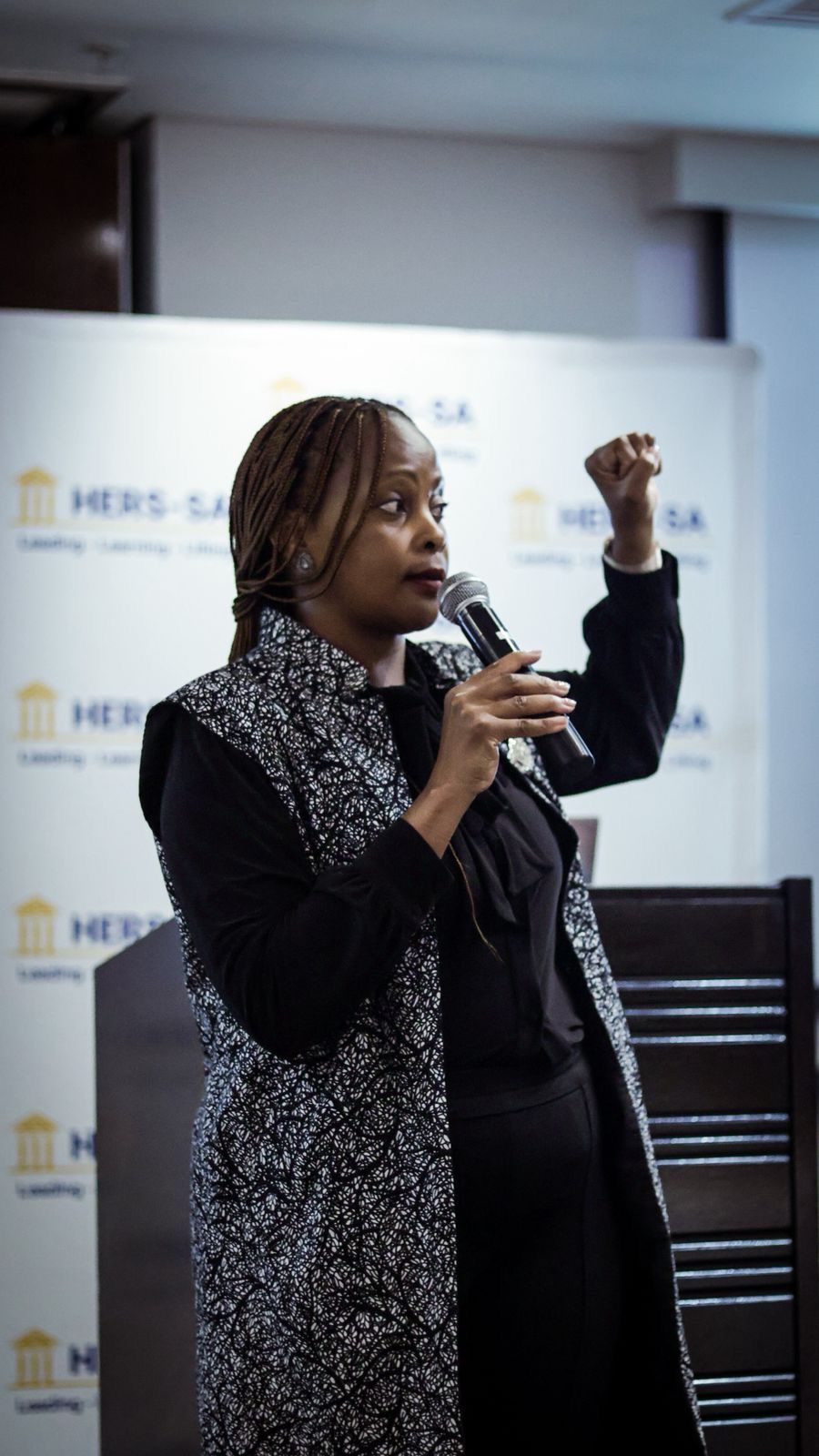
In a powerful and thought-provoking session, Dr Sharon Munyaka facilitated the Power of Coaching masterclass for the HERS-SA Emerging Women in Leadership Programme on 5 May 2025. With her signature blend of insight, empathy, and depth, she explored how coaching can unlock authentic leadership, emotional resilience, and strategic clarity—especially for women navigating leadership in complex academic spaces.
Inspired by this speaking engagement, Dr Munyaka authored the article “The Ebbs and Flows in Leading in Higher Education”, offering a deeper reflection on the lived realities of leadership in South Africa’s higher education sector.
Drawing from her experience as a coach, academic, and leader, she shares how curiosity, compassion, and courage are essential tools for thriving in times of change.
Article By Dr Sharon Munyaka – a Work Psychologist in service of thriving workspaces. Passionate about facilitating leadership conversations, Sharon works with leaders navigating complexity. She anchors them as they lead in uncertain times and co-creates ways of working that optimise behaviour and productivity at work.

Through the lens of one who is deeply in service of higher education, I have walked many paths in this space. I have been a student navigating the complex corridors of learning and belonging. I have lectured and researched, taken up governance responsibilities, stepped into leadership roles, and, importantly, I am a parent, vested in contributing to thriving institutions of higher learning that will shape future generations.
My reflections are not abstract. They are woven from lived experience across multiple institutions of higher education in South Africa. They are shaped by the coaching conversations I hold with leaders who are grappling with the shifting tides of this sector. Together, we sit session after session, in moments of deep honesty, where leaders confess how much higher education has changed and sometimes quietly, sometimes violently.
These are the ebbs and flows of our time.
The Complexity of Today’s Higher Education
The leaders I coach speak of the anxiety of presenting before the Parliamentary Committee on Higher Education. They describe the strain of leading jaded personnel, colleagues who are scraping the bottom of their emotional barrels just to stay engaged. They share the constant tension of economic constraints, salary negotiations, and the never-ending balancing act between academic priorities and administrative overload.
They wade through an avalanche of emails, knowing that while they sit in yet another meeting, critical messages slip through the cracks. They speak of student throughput rates that are under scrutiny, endless compliance demands, and the unrelenting complexity of an institution that never really stops moving.
While the academic project of teaching, research, and community engagement remains intact, competing demands have threatened the balance. Add to this the long-standing tensions between academic staff and professional administrative support staff, and the picture becomes even more layered.
It is easy to feel as though higher education has become too complex to navigate.
Coaching in the Midst of Complexity
Supporting my coaching clients means holding space for them to reimagine how they lead and thrive in this shifting terrain. In every 60-minute session, I focus not on the noise of the institution but on the person in front of me—their thinking, feeling, and doing.
My role is to ask incisive questions that awaken new awareness:
- What must you stay awake to in your current reality?
- What leadership adjustments are required for your style to be fit for purpose?
- How must your own mindset evolve to meet the moment?
Through curiosity, compassion, and courage, coaching becomes a mirror. It shows higher education leaders how they might move from reactive survival to intentional, conscious leadership.
Awakening to the New Reality
Now, more than ever, we must understand the context we are working in. It is no longer enough to simply wake up and come to work, clocking in and clocking out while waiting for retirement.
We need to equip ourselves with a backpack full of essentials to thrive in this new era. This includes:
- Reading and understanding the institutional strategic plan and its annual priorities.
- Knowing the Council resolutions and their implications.
- Fully participating in the academic project—not cherry-picking “pet projects” while leaving administrative responsibilities undone.
- Updating our teaching material to meet the needs of today’s digital nomads, the students can access knowledge globally and demand accountability in how we teach, serve, and engage.
Today’s students are different. Many dial in to lectures from residence or from their home. They are hungry, sometimes literally. They are enraged by delays in funding or the residence allocation. They hold us accountable in ways that might be uncomfortable and topped by social media where everything is happening in real time and going viral.
Our staff are different too. This new cohort of academics and professionals has lives beyond academia. They care deeply about mental health support, relocation assistance, and flexible working arrangements. They want to know how the institution will support their whole selves, not just their job titles.
The reality is this: higher education must level up.
The Human Side of Leadership
As we step into this new reality, leadership in higher education cannot rely on outdated playbooks. It must evolve. My coaching philosophy offers three anchors for this evolution:
Curiosity.
We cannot learn, unlearn, and relearn without curiosity. Leaders must ask: What else is possible? What more can I do? How can I listen better, see clearly, and respond with wisdom rather than fear?
Compassion.
When colleagues say, I can’t cope with this workload anymore, or when students say this system is failing me, we must listen. Truly listen. Mental health is no longer a whisper on the sidelines, it is central to how we function as a community. We must prepare the social soil so that what grows within our institutions is healthy and sustainable.
Courage.
To lead in higher education today is to choose courage over comfort. It means asking hard questions, apologising when we get it wrong, and daring to stand on integrity: Is my contribution building or breaking what has been entrusted to me? Am I showing up in a way that future generations can be proud of?
Co-Creating the Future Together
We can no longer be spectators in higher education. We must all participate: leaders, academics, support staff, students, and parents alike.
We must negotiate openly, update outdated rules, and be willing to learn from global collaborations. We must listen with fresh ears to the new crop of staff and students whose expectations are reshaping the future of higher education.
Ultimately, higher education is still about people. It is about connection, growth, and transformation. It is about preparing the ground for the next generation to thrive, even as we navigate the realities of living in 2025.
So, as we embrace the ebbs and flows, let us remember:
- The waves will keep coming, but how we ride them will define the future.
- The institution needs all of us—not just some of us—to stand up, contribute, and care deeply.
- Together, we can reimagine higher education as a space of possibility, not just complexity.
Because in the end, just like in coaching, transformation happens one conversation, one courageous choice, and one human connection at a time.
Together, in higher education.